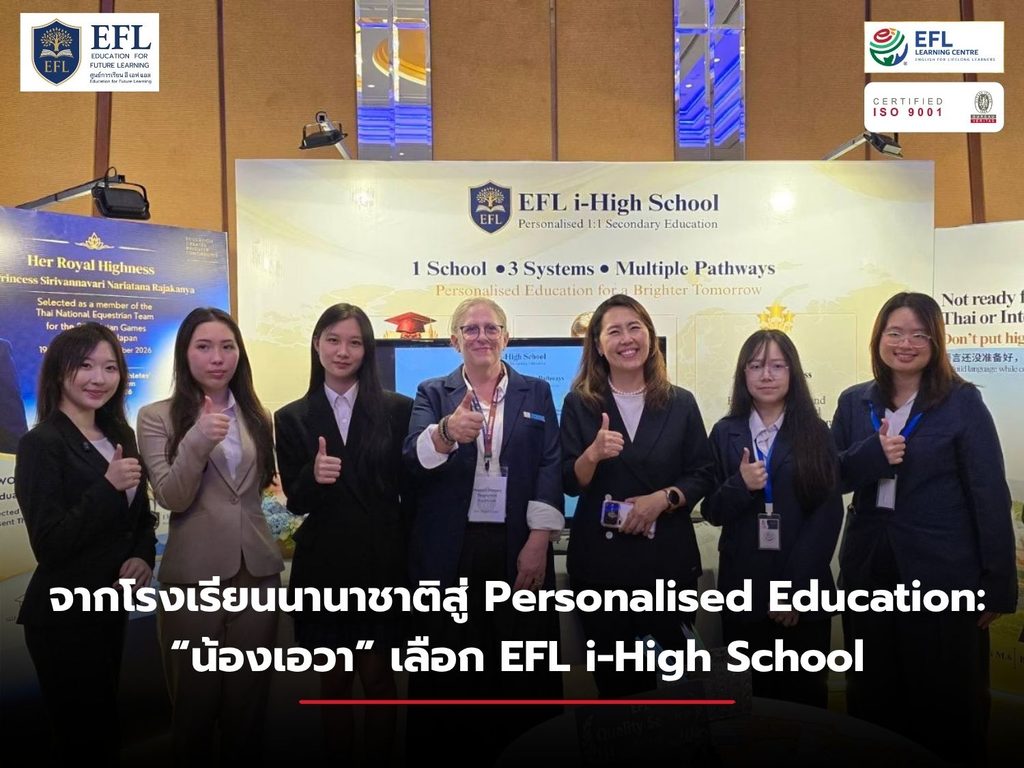
On 3 October 2026, amid a wide range of international schools and educational programmes participating in the Chiang Mai 2026 International School Gateway Fair at Shangri-La Chiang Mai, EFL i-High School (Education for Future Learning) presented an alternative approach to secondary education built around 1:1 Personalised Education.
Designed for students seeking greater flexibility and a learning pathway tailored to their individual goals, EFL i-High School offers an alternative to the conventional school model. The fair brought together international schools, bilingual schools and alternative education providers, giving families the opportunity to explore and compare different educational pathways in one place.
One of the highlights of EFL’s participation was the experience shared by “Aywa,” a high-achieving student at EFL i-High School. Aywa previously studied at a leading international school in Bangkok before deciding to move to an education system that gives her greater freedom to shape her own academic journey through i-High School.
When asked, “Why did you choose EFL i-High School?”, Aywa highlighted four key reasons.
1. “I Wanted to Choose My Own Destination.”
Aywa explained that her previous school provided strong academic support and encouraged students to continue their studies overseas, particularly in the United States, the United Kingdom and Australia.
However, after having the opportunity to travel to these countries herself, she realised that the most important question was not simply which pathway her school expected her to follow, but rather what she was genuinely interested in and where she truly wanted to go.
This became one of the main reasons she began looking for a new education system that starts with the student’s own goals, rather than placing every learner on the same predetermined pathway.
2. Flexible Scheduling + Fast Track = Getting Time Back
After moving to EFL i-High School, Aywa found that her timetable could be designed around her individual needs and priorities.
In addition to greater flexibility in scheduling, students may also consider Fast Track Pathway Options and personalised learning modules that focus specifically on what they need to achieve their academic goals.
Rather than repeating content they have already mastered or waiting for an entire class to progress at the same pace, students can focus on the learning that is most relevant to them.
This reflects the core principle of 1:1 Personalised Education. Instead of asking only, “What grade is the student in?”, the learning process also considers:
What Learning Outcomes has the student already achieved, and what is still required to reach the next goal?
3. More Time to Build a Strong University Portfolio Beyond the Classroom
With a more efficient and personalised academic schedule, Aywa has more time to connect with new groups of friends who share similar interests and to pursue meaningful learning experiences outside the classroom
These include Research & Innovation Competitions supported by EFL, hackathons, and sports such as ice hockey.
Such experiences are more than simply “extracurricular activities”. They can provide valuable evidence of a student’s abilities, interests, leadership, teamwork and problem-solving skills.
Over time, these achievements can also contribute to the development of a strong and distinctive University Portfolio.
4. Targeted University Preparation Without Burnou
Another important reason for Aywa’s decision was the opportunity to prepare for university in a more focused and sustainable way.
The approach is based on a simple principle:
Study what is necessary — but make sure everything you study is aligned with your goal.
Instead of continuously adding more subjects and study hours, EFL begins with the student’s intended destination and then works backwards to identify what the student needs to study, which examinations may be required, and which additional skills or experiences should be developed.
This allows students to prepare for university in a more purposeful way while avoiding unnecessary academic overload and burnout.
In addition, Learning Outcomes supported by appropriate evidence and meeting relevant assessment criteria — including IELTS results, academic achievements, research projects, innovations and extracurricular activities — may be considered as part of the student’s Portfolio development and Learning Outcome assessment process within the EFL learning system.
Any recognition or accumulation of prior learning is subject to the relevant Credit Transfer and Credit Bank criteria applicable to each individual student.